

Our Sustainable Manufacturing: From Weaving to Finishing

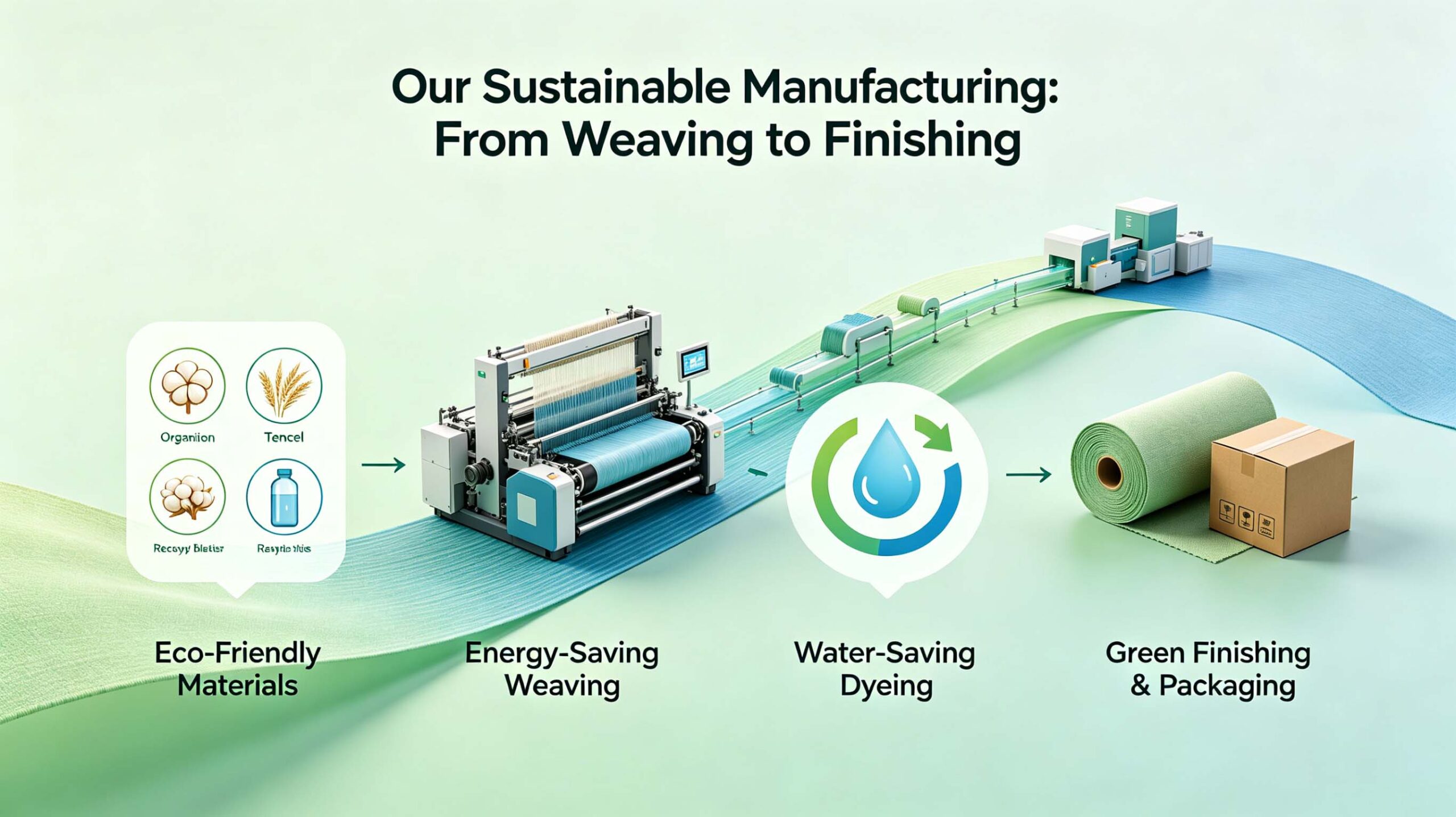
Sustainability is not just a slogan for us, but a full-set standard running through every production link. As a professional fabric manufacturer, we have upgraded our entire production workflow, from raw material selection, weaving, dyeing and printing to final finishing and packaging. We focus on reducing resource consumption, cutting carbon emissions and minimizing environmental impact, while keeping stable fabric quality and competitive lead time. This article will take you through our eco-friendly manufacturing process step by step.
1. Eco-Friendly Raw Material Selection: The First Step of Green Production
Sustainable manufacturing starts with raw materials. We strictly select low-carbon, renewable and recycled fibers to build a green supply chain.
We prioritize Tencel/Lyocell, linen, organic cotton, recycled polyester (rPET) and recycled nylon as our core raw materials. Tencel is made from sustainably harvested wood pulp with a closed-loop production system; linen is a natural carbon-negative fiber that requires little water and pesticides during planting. For recycled fibers, we only adopt materials with complete GRS certification, sourced from recycled plastic bottles, textile waste and industrial leftover materials.
Before entering production, all raw materials will go through strict inspection. We reject fibers containing harmful substances and unqualified raw materials, to ensure every roll of fabric is compliant with OEKO-TEX Standard 100, GOTS and other international eco-standards. This strict selection also helps our clients meet the environmental requirements of European, American and other global markets.
2. Energy-Saving & Low-Emission Weaving Workshop
Traditional weaving usually consumes large amounts of electricity and generates noise and dust. We have comprehensively renovated our weaving workshop to achieve energy conservation and clean production.
We replaced old-fashioned looms with high-efficiency digital weaving machines and computerized jacquard looms. These new devices cut power consumption by nearly 30% compared with traditional equipment, and operate with lower noise. Meanwhile, we installed professional dust collection and ventilation systems to collect flying yarn and fiber debris in real time, improving the working environment and avoiding air pollution.
In terms of production management, we optimize weaving schedules to reduce machine idle time and material waste. For sample production and small-batch orders, we adopt digital pre-simulation technology, which effectively reduces trial weaving waste and improves the utilization rate of yarn. Whether it is plain fabric, striped fabric or complex jacquard fabric, we can complete weaving with less resource loss.
3. Water-Saving Dyeing & Printing: Closed-Loop Water Recycling
Dyeing and printing are the links with the largest water consumption in textile production. We have built a complete closed-loop water recycling system to solve the problem of water waste and sewage discharge.
All production wastewater will be collected, filtered, purified and recycled after professional treatment. The recycled clean water can be reused for production processes such as pre-washing and rinsing. At present, our overall water recycling rate has reached over 80%, greatly reducing the use of fresh water.
In addition, we exclusively use environmentally friendly dyestuffs and water-based printing pigments that are free of formaldehyde, heavy metals and harmful azo dyes. We abandon high-pollution chemical auxiliaries and adopt low-carbon, biodegradable additives. For printed fabrics, digital direct printing technology is widely applied, which uses less pigment and produces no excess waste liquid compared with traditional screen printing. Every batch of dyed and printed fabrics will be tested for color fastness and safety, balancing eco-friendliness and product performance.
4. Green Finishing: Functional Treatment Without Pollution
Fabric finishing determines the final hand feel, function and durability. We combine practical functional finishing with environmental protection, refusing harmful chemical treatments.
We provide popular functional treatments including wrinkle-resistant, water-repellent, antibacterial, anti-static and UV protection. Different from traditional high-pollution finishing agents, we use plant-based and PFAS-free eco-finishing solutions. These treatments will not damage the fiber texture, and the functional effect can last after repeated washing, while ensuring no harmful residues on the fabric surface.
During the finishing process, we control the temperature and steam of setting machines accurately to save heat energy. Unqualified semi-finished products will be classified and recycled instead of being discarded directly. After finishing, workers will conduct manual and machine double inspection to check fabric width, weight, hand feel and surface condition, ensuring the finished fabrics meet clients’ technical requirements.
5. Low-Waste Packaging & Logistics Optimization
The sustainable process extends to the final packaging and delivery stage. We stick to minimal and recyclable packaging to cut plastic waste.
We gradually replace disposable plastic films with recyclable woven bags, kraft paper and biodegradable packaging materials. Each fabric roll is labeled with paper tags instead of plastic labels. For internal leftover fabrics and cutting scraps, we classify and recycle them uniformly, and cooperate with professional recycling factories to reprocess textile waste, realizing circular utilization.
In terms of logistics, we optimize container loading plans to improve loading rate and reduce transportation times, so as to lower carbon emissions during delivery. We also choose logistics partners with green transportation concepts, to form a complete sustainable chain from factory to warehouse.
6. Our Continuous Commitment to Sustainability
Sustainable manufacturing is an ongoing journey for our factory. We keep investing in equipment upgrading and technological research, learning advanced green production technologies in the textile industry. We also train all staff regularly to raise awareness of environmental protection, making eco-production a common practice for every team member.
We understand that more and more global brands and buyers regard sustainable production as a core cooperation standard. By optimizing every link from weaving to finishing, we not only protect the environment, but also deliver safe, high-quality and certified fabrics for our partners.
Final CTA
If you are looking for a reliable fabric supplier with mature sustainable production systems, welcome to contact us. We supply linen, Tencel, jacquard, printed and home textile fabrics with complete eco-certifications. Request free samples and production reports now to start your sustainable sourcing journey.


